
Chief of Army Staff Gen Manoj Pande has carried out a comprehensive review of India's military preparedness along the Line of Actual Control (LAC) in Arunachal Pradesh in his first visit to the border state after last month's clash between Indian and Chinese forces in the Tawang sector.
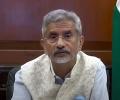
The external affairs minister said the broad principle around which his position would be constructed would be about the importance of maintaining peace and tranquility along the border for the overall development of ties which has been reflected in the last 30 years of the relationship.

India and China have agreed to work towards a "roadmap" for rebuilding mutual trust following the border standoff in eastern Ladakh, according to a statement from the Indian Defence Ministry. Defence Minister Rajnath Singh met with his Chinese counterpart Dong Jun in Vientiane, Laos, on the sidelines of a regional security conclave. Singh called for drawing lessons from the "unfortunate border clashes" of 2020 and emphasized the need for cooperation rather than conflict. Both sides agreed to work towards a roadmap for rebuilding mutual trust and understanding, and a meeting of the Special Representatives and Secretary-Vice Minister mechanism will also take place soon.

Jaishankar said that both sides also exchanged views on the next steps in the India-China bilateral ties.
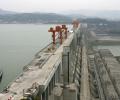
China defends its construction of a dam on the Brahmaputra river in Tibet, addressing concerns from India and Bangladesh about its potential impact on water flow and the environment.
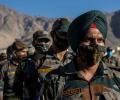
In a strong response to China's objection to development of infrastructure on the Indian side of the LAC, New Delhi also asserted that Beijing has no locus standi to comment on India's internal matters.

The grandson of Ghulam Rasool Galwan, after whom the Galwan Valley was named, Amin Galwan said on Thursday that a "war between India and China is not a solution and the issue should be resolved with talks".
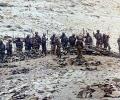
'The Galwan Valley clashes helped us prioritise our national security approach towards the northern border'
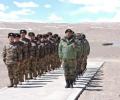
At present, the Chinese Army has diverted its troops carrying out a massive exercise on their side of the LAC and deployed them at short notice across the Line of Actual Control in the areas under the Indian Army's 81 and 114 Brigades deployed to counter the Chinese assertions from Daulat Beg Oldie and adjoining areas.
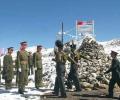
India on Monday pressed for early disengagement of troops in remaining friction points in eastern Ladakh during a fresh round of high-level military talks with China, people familiar with the matter said.

The gap between the existing air bases in China close to the LAC for fighter aircraft operations was around 400 kms but this would be bridged with the operationalisation of the Shakche airfield.

In its first official account of the standoff between the two militaries, the ITBP revealed how its troops "not only effectively used shield to protect themselves but also responded fiercely to advancing PLA (Chinese People's Liberation Army) troops and brought the situation under control". "The ITBP has recommended the names of 21 men who faced the Chinese during the face-offs and skirmishes in May-June this year for gallantry," it said.

The meeting came after the Indian Army thwarted an attempt by the Chinese Army to transgress into Indian areas near the southern bank of Pangong Tso near Chushul in Ladakh on the intervening night of Saturday and Sunday.

The last meeting between the two sides at the Corps Commander level was held in December last year.

After a gap of over three months, India and China on Wednesday are holding another round of high-level military talks to resolve the 20-month-long military standoff in the remaining friction points in eastern Ladakh, sources in the security establishment said.

The people familiar with the development said the new bridge is being built in an area that is over 20 km from the Line of Actual Control (LAC).

The work on a link-road in Demchok in South-eastern Ladakh region has been stopped after objections were raised by the Chinese Army, barely months after repeated incursions by it in that area.

The delegations were led by Brigadier JKS Virk from the Indian side and Senior Colonel Chen Zheng Shan from the Chinese side

On Monday China said it has "effectively managed and controlled" frictions in certain border areas.

'If China shows greater concerns for Indian interests, ties could improve. Otherwise, the thaw could be short-lived.'
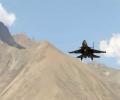
A Chinese Air Force aircraft flew very close to a friction point in the eastern Ladakh sector on the Line of Actual Control in the last week of June, after which the Indian Air Force responded swiftly as per standard operating procedures.
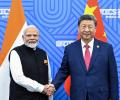
India and China celebrated the 75th anniversary of their diplomatic relations on Tuesday, with leaders from both countries exchanging congratulatory messages. The anniversary comes as the two countries are working to restore ties after a four-year freeze due to the military standoff in eastern Ladakh. Both countries have expressed a willingness to enhance strategic mutual trust and step up cooperation in various fields. The two sides are also exploring ways to rebuild ties and promote people-to-people exchanges.

India is looking forward to a "constructive" dialogue with China to resolve issues in remaining friction points in eastern Ladakh, sources in the security establishment said on Monday ahead of the 14th round of military talks between the two sides on the 20-month row.
India on Tuesday outrightly rejected as 'senseless' China renaming some places in Arunachal Pradesh, and asserted that assigning 'invented' names does not alter the reality that the state 'is, has been, and will always be' an integral part of India.

India on Thursday once again called for completion of the disengagement process at the remaining friction points in eastern Ladakh to pave the way for both the Indian and Chinese troops to consider de-escalation and ensure full restoration of peace and tranquillity in border areas.

Ministry of External Affairs (MEA) spokesperson Arindam Bagchi said China continues to deploy a large number of troops and armaments in the border areas and it was in response to Chinese actions that the Indian armed forces had to make appropriate counter deployments.
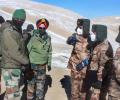
'We hope the Indian side will work with China to follow through the important consensus of our two state leaders, abide by relevant agreements and treaties to de-escalate the tension at the border'
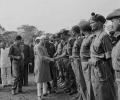
The well-fought defensive battles in Aksai Chin and eastern Arunachal, in remote and forbidding locations such as Galwan, Rezang La, Gurung Hill and Walong, effectively halted Chinese advances not once but twice during the campaign. These engagements, fought with grit and without adequate support, were not immediately known to the world in 1962, points out Dr Kumar.
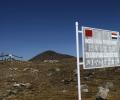
China on Wednesday defended its move to release a new 'standard map' for 2023 showing Arunachal Pradesh and Aksai Chin as part of its territory, saying that it is a 'routine practice' in accordance with its law and urged India to 'stay objective and calm' and refrain from 'over-interpreting' the issue.

The NSA particularly highlighted the need for resolving outstanding issues as quickly as possible and talked about the need for maturity and sincerity in dealing with the issue.

The Defence Research and Development Organisation (DRDO) in Leh has conducted research on the double hump or Bactrian camels which can carry load of 170 kilogrammes at an elevation of 17,000 feet height in the Eastern Ladakh region.

The fresh round of Corps Commander-level talks took place at the Chushul-Moldo border point on the Chinese side of the Line of Actual Control in eastern Ladakh, they said.
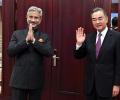
If the visit takes place, it will be the first trip by a senior Chinese leader to India after the eastern Ladakh standoff between the two countries began in May 2020.

India and China on Friday are holding another round of high-level military dialogue to resolve the 22-month-long standoff in some friction points in eastern Ladakh, two months after the last round of such talks failed to yield any significant outcome.
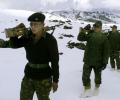
They said the Chinese troops came to the Indian side of the border in the garb of nomads and pitched the tents.

"The IAF chief flew a MiG-21 Bison fighter aircraft during the visit where he interacted with the aircrew and reviewed the operational preparedness," IAF officials said.
The sources said the ongoing engagement and dialogue at military and diplomatic levels have resulted in complete disengagement of troops at patrolling point 14, 15 and 17 A in eastern Ladakh.
Indian Army Chief General M M Naravane had said on Wednesday that India was hopeful of resolving issues related to disengagement at Patrolling Point 15 (Hot Springs) in eastern Ladakh in the 14th round of talks.

Air Chief Marshal Bhadauria asked the air warriors to maintain a very high-level of alertness considering the evolving situation in Pangong lake region in eastern Ladakh following China's unsuccessful attempts to occupy certain strategic points in the area, the officials said on Thursday.
The talks are following up the outcome of the 19th round of Corps Commander-level talks held between the two sides on August 13-14 at the Chushul Moldo border meeting point.
